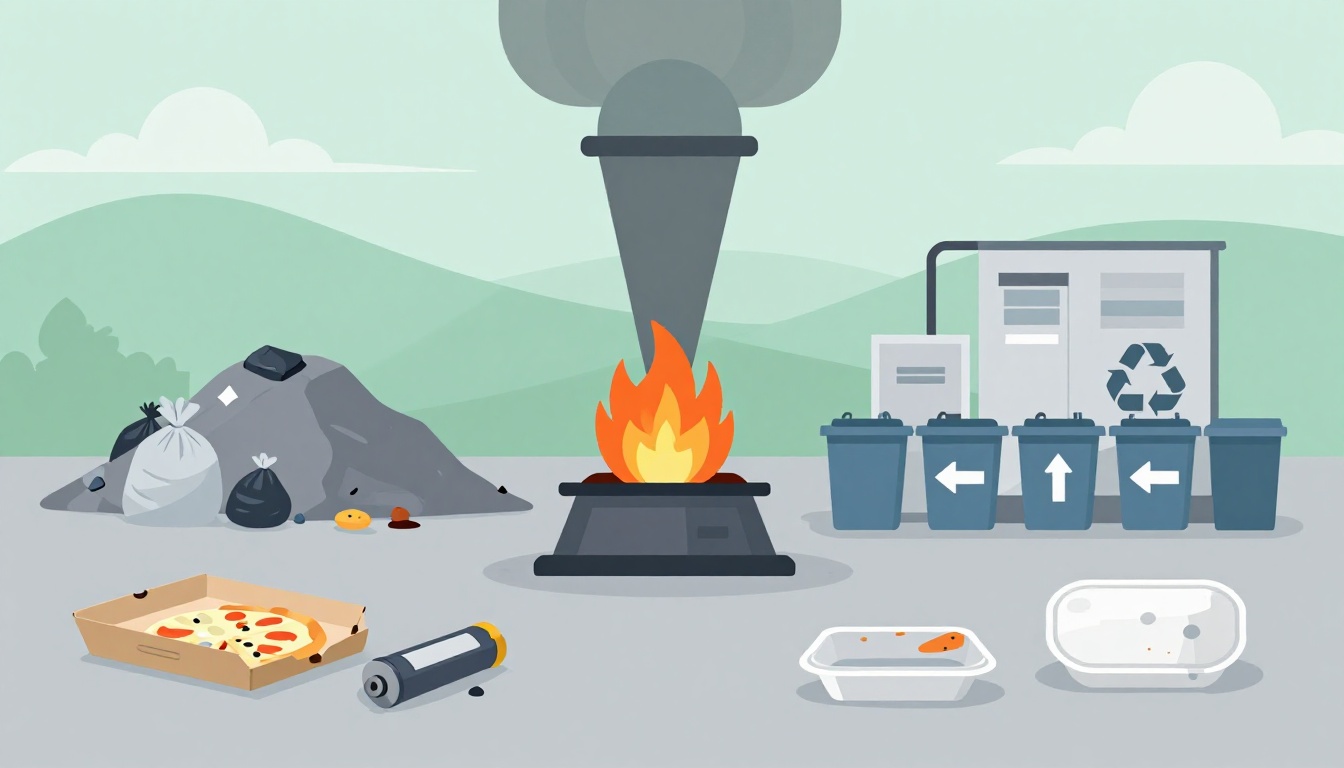
Ever sort your trash, then wonder, “Where does it all go?” Think about greasy pizza boxes, old batteries, or takeout containers with food stuck inside. They might look “sortable,” but many items still end up as non-recyclable waste.
Non-recyclable waste is what recycling programs cannot handle because it’s too dirty, mixed with the wrong materials, contaminated, or too hazardous to process safely. In the US, landfills still take about half of municipal solid waste. In 2018, EPA data showed 50% went to landfills, 12% went to incineration with energy recovery, and 32.1% was recycled (plus 8.5% composted).
So what happens next? You’ll see the common categories of trash you can’t recycle, then the three main disposal paths, and how those choices affect air, water, climate, and local communities. By the end, you’ll have practical ways to cut the non-recyclable pile from home.
Everyday Items That End Up as Non-Recyclable Waste
Most of the time, “not recyclable” does not mean “forever trash.” It means the material can’t get processed safely or cleanly enough at that moment.
Here are common items that often fail the recycling sorting line in the US, plus what blocks them.
| Item you might toss | Why recycling stalls | What usually happens instead |
|---|---|---|
| Greasy pizza box, food-stained paper | Oil and food cause contamination | Trash or compost rules (if clean, not greasy) |
| Used takeout containers with scraps | Food residue spreads during handling | Trash |
| Broken ceramics (cups, dishes) | Hard, mixed materials, plus broken bits | Trash |
| Styrofoam (some types) | Many facilities do not accept it | Trash (or special drop-offs) |
| Batteries, paint, chemicals | Hazard risk to workers and facilities | Household hazardous waste drop-off |
| Electronics, cables | Needs special recycling to recover metals | E-waste drop-off |
| Mixed “random” trash | Too many materials together | Trash, since sorting is too costly |
Once waste is contaminated or mixed, it becomes like soup with sand inside. You can’t “just pour it back” into separate ingredients.
Below are a couple of the biggest categories you’ll recognize from home.
Food-Soiled Packaging and Why It Clogs Recycling
Greasy paper is one of the most common “why did this end up in trash?” surprises. A pizza box can look like normal cardboard, but food oils soak in. Takeout containers and snack wrappers often carry grease or leftover sauce.
When these items hit a recycling facility, they cause problems fast:
- Contamination spreads to other paper products.
- Sorters and washers can’t clean it enough to keep it usable.
- The material may get rejected to protect the whole batch.
In simple terms, recycling needs inputs that stay clean and separated. Food-soiled items break that rule. Because of that, facilities often treat them as a mix of fibers and residue, not a steady paper stream.
If you want a quick home rule, think like this: If it’s greasy, it’s not “paper-clean” anymore. When in doubt, follow local guidance for what your area accepts.
Tricky Materials Like Ceramics and Batteries
Not all “non-recyclable” items fail for the same reason. Some fail because they are hard to process. Others fail because they are unsafe.
Broken ceramics (like old plates and cups) can be a good example. Ceramics often contain mixes that do not behave like paper, metals, or common plastics. They also break into sharp fragments. That makes them tough for normal sorting lines.
Batteries are different. A common problem is not just recycling difficulty, but safety. Old household batteries, paint, solvents, and similar items can leak or react if handled the wrong way. That creates risks for workers and can lead to harmful waste streams.
Electronics face another set of issues. They may contain metals and chemicals that require specialized recovery. Most curbside programs avoid that work because it needs training, equipment, and careful processing.
So, the takeaway is simple. Food-soiled trash breaks recycling quality, while hazardous and complex items break safety and processing rules.
The Three Main Paths for Non-Recyclable Trash
When waste cannot be recycled through your local program, it still goes somewhere. Most non-recyclable trash ends up in one of three large paths: landfills, incineration, or waste-to-energy systems.
The EPA’s materials management hierarchy starts with source reduction, then reuse, then recycling and composting. After that, it discusses energy recovery and disposal. You can see the hierarchy and its order on the EPA site in Non-Hazardous Materials and Waste Management Hierarchy. (That order matters because it helps prevent waste from being created in the first place.)
See: Non-Hazardous Materials and Waste Management Hierarchy – EPA
Here’s how the three paths typically compare.
| Path | What it does | Main upsides | Main downsides |
|---|---|---|---|
| Landfill | Bury trash in lined, managed sites | Often cheapest, widely available | Creates methane as waste decomposes |
| Incineration | Burn trash at high heat | Huge volume reduction | Needs strict air controls to manage pollutants |
| Waste-to-energy (WTE) | Burn or process waste to make power or fuel | Cuts landfill demand, recovers energy | Can be costly to build and run |
Still, each facility and region is different. So impacts depend on local rules and technology.
Buried in Landfills: The Most Common Stop
Landfills are not just holes in the ground. Modern landfills are engineered, lined, and monitored. EPA describes key basics and how landfills work on Basic Information about Landfills.
See: Basic Information about Landfills | US EPA
Here’s the basic story: trash gets placed in layers, compacted, and covered. Over time, organic material breaks down. In the process, landfill gas forms, including methane, which is a strong climate gas.
EPA’s latest full-year methane inventory data show landfill methane makes up around 15% of US human-caused methane (based on 2022 data). That is why landfill management matters so much. Facilities collect gas for treatment or use, then manage emissions to reduce harm.
Another issue is leachate, the liquid that can collect from waste and moisture. Landfills use controls and treatment systems to manage leachate and protect nearby groundwater. Still, leaks or failures are a risk, which is why monitoring stays a big deal.
Landfills also take space. Even when they manage gas well, they still become long-term storage for materials that could have been reduced earlier.
The landfill isn’t just storage. It’s an ongoing chemical process.
Burned Up in Incinerators and WTE Plants
Incineration is a heat process. In many systems, facilities burn non-recyclable waste in controlled conditions. Modern plants use air pollution controls to reduce smoke and other byproducts.
In the US, energy recovery facilities often fall under waste-to-energy. The EPA explains energy recovery from combustion and why WTE plants exist on:
Energy Recovery from the Combustion of Municipal Solid Waste (MSW) | US EPA
Compared with landfilling, incineration and WTE can reduce bulk quickly. That means less trash takes up landfill space later.
However, “burning” has its own challenges. Facilities need strong pollution controls for things like fine particles and certain trace pollutants. The quality of operations matters, and costs are higher than landfilling in most places.
If you want a plain-language look at how incineration works and what people discuss, EPA’s A Citizen’s Guide to Incineration can help you understand the basics.
So what happens to non-recyclable waste in these plants? It gets converted into heat, and then into electricity (in many WTE setups). What remains is mostly ash and scrubber residue, which then still requires careful disposal.
How Non-Recyclable Waste Hurts the Planet
Non-recyclable waste affects the planet in several ways, even when the system follows the rules.
First, landfills can drive climate impacts through methane. Methane is powerful, and it forms as organic waste decomposes. Gas capture helps, but the process can’t be perfect forever.
Second, waste can affect water. Landfills use liners and leachate systems, yet groundwater protection depends on long-term management. Incineration and WTE also involve wastewater handling from scrubbers and cleaning systems.
Third, burning can add pollution risks if controls fail or if emissions monitoring is weak. Modern plants use filters and systems to reduce pollutants. Still, compared to reducing waste at the source, disposal always has an environmental footprint.
Finally, non-recyclable waste can harm wildlife when hazardous items or litter escape proper handling. Batteries, chemicals, and electronics are especially risky if they end up in the wrong place.
On the flip side, there are some climate benefits from better landfill gas capture and from WTE that offsets power from other fuels. The key idea is balance. Systems can be improved, but less waste still wins.
Promising Tech and Rules Changing Waste’s Fate
The future is not only about bigger bins. It’s also about better rules, better sorting, and better handling of the hard-to-recycle stuff.
As of March 2026, a few trends stand out:
- Plasma gasification and pyrolysis: These convert waste into syngas and leftover material like slag. Still, supporters and critics debate how they should be classified and regulated. Some systems struggle with approvals and consistent performance.
- Stronger air controls and monitoring: Many facilities upgrade filtration and testing for fine particles and other emissions.
- More focus on hazardous waste prevention: Local rules and education keep pushing safer disposal for batteries, paint, and chemicals. That helps prevent dangerous materials from contaminating regular trash.
- More specialized drop-offs: Many communities expand e-waste events and household hazardous waste programs, so tricky items do not end up in general bins.
If you want a practical tool for figuring out where something goes, EPA has an Incident Waste Decision Support Tool (I-WASTE DST) to guide disposal and handling decisions:
Disposal Guidance | I-WASTE DST | US EPA
Even with better tech, the biggest shift is still behavior. When you reduce the amount of contaminated packaging and properly divert hazards, you lower the volume of waste that needs disposal.
Conclusion
When you toss something that cannot be recycled, it usually follows one of three paths: it gets buried in landfills, burned in incinerators, or processed for energy in waste-to-energy plants. Each option has tradeoffs, especially for methane, air quality, and long-term waste storage.
The strongest takeaway is also the simplest: reduce what you buy, reuse what you can, and avoid contamination in the first place. Greasy paper, mixed materials, and hazardous items are common reasons waste loses its recycling chance.
This week, do a quick trash audit. Look for one item category you can prevent or divert, then share what you find with someone who sorts trash too. If waste was the question you started with, prevention is the answer that lasts.